Stable vitiligo:
Patches that have not grown, with no new ones, for about a year. This matters most: surgery on vitiligo that is still spreading usually fails, so stability is checked before anything is planned.
This isn't a cover-up.
This is
your colour.
Vitiligo surgery in New Delhi, by a dermatologist
For white patches of vitiligo, also called leucoderma or safed daag, that have stopped spreading but will not fill in with creams and medicines. Surgery moves your own pigment cells into the patch so the colour can return, done by Dr. Punam Singh, a dermatologist trained in melanocyte transfer, punch grafting and suction blister grafting.
It starts with a skin examination, not a promise. You find out whether your patches are stable enough for surgery, which method suits them, what result to expect and the full cost.
It may start as one pale spot near the lips, on the fingers or around the eyes. Then another. You notice people's eyes go to it before they look at you.
So you wear full sleeves in summer, hide your hands in photos, use a concealer that never quite matches, and answer the same questions at every family function, often including questions about marriage.
That isn't your fault. Vitiligo is not contagious and not caused by what you eat, and once the patches stop spreading, your own colour can often be brought back.
Keep reading, because the right treatment for safed daag starts with knowing whether your vitiligo is stable, and surgery is only one of the answers.
Book a skin examinationVitiligo surgery is for people whose white patches have stopped spreading, usually for a year or more, and have not filled in with creams or medicines. Patients come to Dr. Punam for vitiligo treatment from Karol Bagh, Rajendra Nagar, Rajouri Garden, Janakpuri, Dwarka and across West Delhi.
Patches that have not grown, with no new ones, for about a year. This matters most: surgery on vitiligo that is still spreading usually fails, so stability is checked before anything is planned.
Vitiligo confined to one area or one side of the body, a few patches that creams have not filled: these respond best to surgery, and often need only one sitting.
Areas where medicines rarely bring colour back on their own. Punch grafting and melanocyte transfer are often the most reliable way to repigment them.
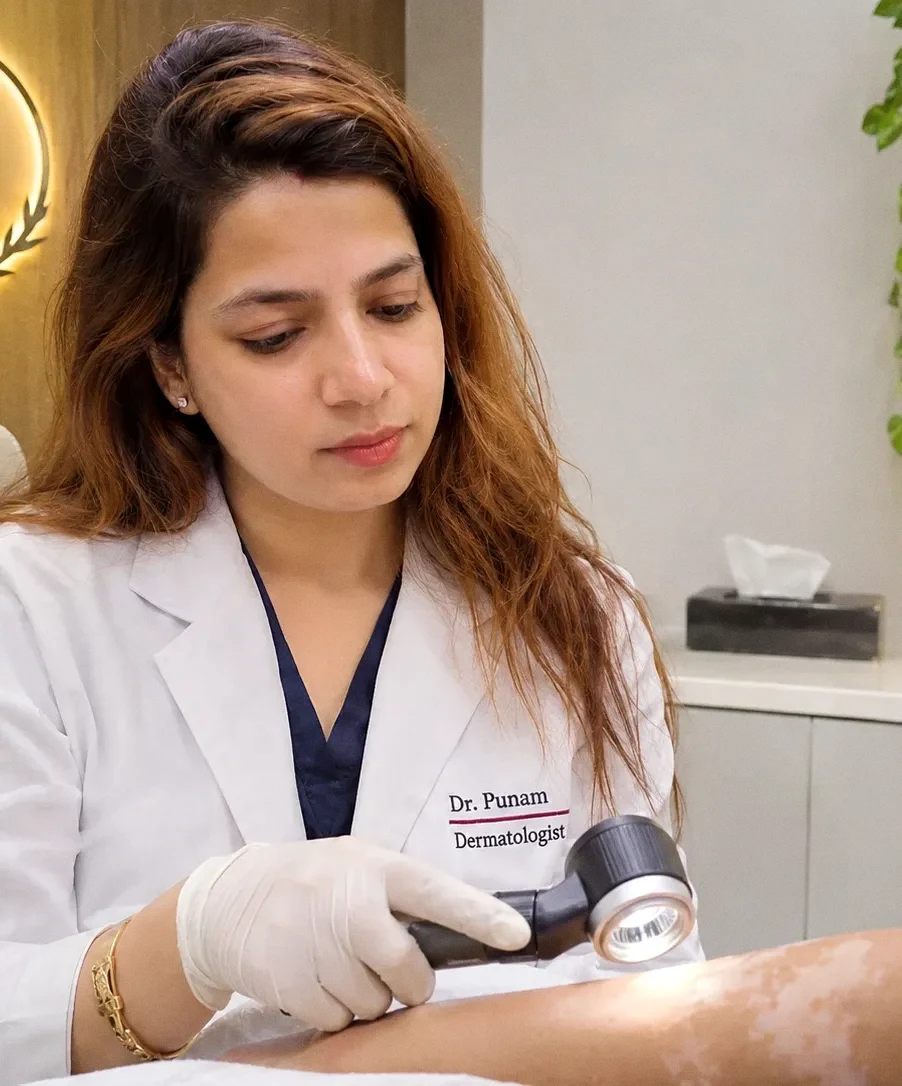
One unhurried visit with Dr. Punam: your patches examined closely, how long they have been stable, and whether medicine or surgery is the right next step for you. You know before anything is booked.
Colour
Vitiligo surgery moves healthy pigment cells (melanocytes) from normal skin, usually the thigh or behind the ear, into a stable white patch, where they settle and slowly bring colour back. It is done under local anaesthesia as a day procedure.
Dr. Punam uses three methods: melanocyte transfer for larger areas, miniature punch grafting for small, stubborn patches, and suction blister grafting for thin skin such as the lips.
Here's how it works:
Stability is checked first: no new or growing patches for about a year. Then the method is chosen for the size and site of your patches.
The donor skin and the white patch are numbed with local anaesthesia, so you are awake and comfortable throughout.
A thin layer, tiny punches or blister roofs of normal skin are taken from the donor area, which heals within one to two weeks.
Pigment cells are spread over the prepared patch, or tiny grafts placed into it, and the area is dressed to keep them in place.
Dressings come off in about a week. Colour usually starts to show in 4 to 6 weeks and keeps filling in over 3 to 6 months.
White patches have several causes, and not all of them are vitiligo. Dr. Punam is a dermatologist with special training in dermato-surgery, including vitiligo surgery, so the diagnosis, the decision on whether surgery will work and the surgery itself all come from the same doctor.
Why patients choose
a dermatologist
Honest answers.
No miracle cures.
Vitiligo treatment is not one procedure. It is a plan: keeping the vitiligo stable, surgery when the time is right, and follow-ups while the colour returns.
White patches can also be a fungal infection, pityriasis alba or another condition. Vitiligo is confirmed before anything is planned.
If your patches are still spreading, you are told to wait and treat them with medicine first, because surgery would not hold.
Melanocyte transfer, punch grafting or suction blister grafting, chosen for the size and site of each patch.
Many stable patches regain good colour, but results vary from patch to patch. You hear what to expect for yours before you decide.
Check-ups through the months repigmentation takes, with medicine to help it along where needed.

Your own cells.
Your own colour.
Vitiligo surgery cost in Delhi depends on four things, and you get all four in writing after your skin examination:
Most of the cost follows the area to be treated: a small patch on a finger or the lip costs far less than large areas on the body.
Punch grafting, suction blister grafting and melanocyte transfer take different time and equipment, so each is priced differently.
Many patches need one sitting; some need a second, shorter session for spots that fill in slowly.
Medicines that help the colour spread and your follow-up visits are written into the plan, so nothing is added later.
This starts with a skin examination
Vitiligo surgery in New Delhi, for patients from Karol Bagh, West Delhi and Dwarka. Book yours.
If no patch has grown and no new one has appeared for about a year, your vitiligo is likely stable enough for surgery. If it is still spreading, medicine comes first.
When months of creams and tablets have not filled a patch, surgery brings in the pigment cells that the patch no longer has.
These areas rarely regain colour with medicine alone, and are often where vitiligo surgery helps most.
It depends on stability and site: stable patches on the face and body often repigment well, fingertips and lips more slowly. You hear what to expect for yours before you decide.

Before you book, ask yourself
If no patch has grown and no new one has appeared for about a year, your vitiligo is likely stable enough for surgery. If it is still spreading, medicine comes first.
When months of creams and tablets have not filled a patch, surgery brings in the pigment cells that the patch no longer has.
These areas rarely regain colour with medicine alone, and are often where vitiligo surgery helps most.
It depends on stability and site: stable patches on the face and body often repigment well, fingertips and lips more slowly. You hear what to expect for yours before you decide.
Vitiligo surgery cost in Delhi depends mainly on the size of the area to be treated, then on the method (punch grafting, suction blister grafting or melanocyte transfer), the number of sittings and the follow-up care. Dr. Punam examines your patches and gives you the full cost in writing before you decide.
Vitiligo can be controlled, and in stable patches the colour can often be brought back with medicine or surgery. No treatment can promise that new patches will never appear elsewhere, so anyone offering a guaranteed permanent cure is not being honest with you.
No. Vitiligo does not spread from person to person by touch, by sharing food, utensils or clothes, or through blood. It is not an infection.
Vitiligo happens when the body's own immune system attacks the pigment cells (melanocytes) in parts of the skin. Genes, stress, illness or injury to the skin can set it off. It is not caused by eating the wrong food, and it is not anyone's fault.
Vitiligo can run in families, but most children of a parent with vitiligo never develop it. Having a relative with vitiligo raises the chance slightly; it does not decide it.
No food has been proven to cause or cure vitiligo, including the well-known belief about fish and milk. A normal, balanced diet is enough; strict diet charts are not needed and can do more harm than good.
Vitiligo is called stable when no new patches have appeared and the existing ones have not grown, usually for about a year. Stability matters because surgery only holds on patches that have stopped spreading.
It depends mostly on stability and on where the patch is. Stable and segmental vitiligo on the face and body often regain good colour, while fingertips, lips and joints respond more slowly. Dr. Punam tells you what to expect for your own patches before you decide.
Vitiligo surgery is done under local anaesthesia, so most people feel only the first injections. You go home the same day; the dressings come off in about a week, the donor area heals in one to two weeks, and most people return to work within a few days.
Each suits a different patch. Miniature punch grafting works well for small, stubborn patches; suction blister grafting gives a smooth result on thin skin such as the lips; melanocyte transfer covers larger areas from a small piece of donor skin. The examination decides which is right for you.
Yes. Lip vitiligo often does not respond to creams alone but responds well to surgery once it is stable, with suction blister grafting or punch grafting commonly used to bring the colour back.
Yes. Children are usually treated first with medicines suited to their age. Surgery is considered only for older children whose patches are clearly stable, and is decided case by case with the family.
Yes. Vitiligo does not affect your health, fertility or ability to have children, and it cannot pass to a partner. It is a skin condition, not a reason to step back from any part of life.
Yes. Patients come to Dr. Punam for vitiligo treatment and vitiligo surgery from Karol Bagh, Rajendra Nagar, Patel Nagar, Rajouri Garden, Janakpuri, Dwarka and across West Delhi. Send an enquiry and the clinic team calls you back to fix a time.
Your skin, your colour, back.
Book a skin examination